The most common living room design mistake isn't a bad paint color or the wrong sofa. It's a rug that's too small. A 5 x 8 rug marooned in the middle of a big room, with every piece of furniture pushed back around it, makes the space look scattered and smaller than it is. The good news is that rug sizing follows a few simple rules, and a roll of painter's tape tells you more than any online calculator.
Start With the Standard Sizes
In the US, most area rugs come in a handful of standard dimensions:
- 4 x 6 feet
- 5 x 8 feet
- 6 x 9 feet
- 8 x 10 feet
- 9 x 12 feet
- 10 x 14 feet
- Runners, rounds and custom sizes beyond that
Prices jump significantly at each step, especially in wool, which is one reason people under-buy. But the jump from 5 x 8 to 8 x 10 often does more for a room than a new coffee table.
The Three Layouts
There are three accepted ways to put a living room rug under a seating group. Pick the one that fits your room and your budget, then size the rug to match.
Layout 1: All Legs On
Every piece of furniture in the seating group sits entirely on the rug: sofa, chairs, side tables, all four legs each. This creates the most pulled-together, luxurious look and visually defines the living area, which is especially useful in an open floor plan.
Typical size: 9 x 12 feet or larger for a standard sofa, two chairs and a coffee table. In a big room, 10 x 14.
Rule of thumb: the rug should extend at least 6 inches beyond the ends of the sofa and behind the back legs of every chair.
Layout 2: Front Legs On
The front legs of the sofa and chairs sit on the rug, and the back legs sit on the bare floor. This is the most popular layout because it ties the furniture together without requiring a huge rug. It also works well when a sofa is against a wall.
Typical size: 8 x 10 feet for most average living rooms; 6 x 9 can work in a small room with a loveseat.
Rule of thumb: at least 6 to 8 inches of the rug should be under the front legs. The rug should still be wider than the sofa, ideally by 6 inches or more on each side.
Layout 3: Coffee Table Only (the "Floating" Rug)
No furniture touches the rug; it sits under the coffee table alone. This can work in a very small room, a tight apartment, or when you're layering a small decorative rug over a larger one. In most rooms, though, it's the mistake we warned about at the top.
Why it fails: the rug becomes an island. Instead of linking the furniture, it separates it, and the eye reads three or four unrelated objects rather than one comfortable grouping.
When it works: if your sofa and chairs are pulled close around a small table and the rug still extends well past the table on all sides, it can look intentional. Aim for the rug to be at least as long as the sofa minus a foot or so. A 4 x 6 under a coffee table in front of an 84-inch sofa will look undersized.
How to Measure Your Room
- Leave a border of bare floor. In most rooms, you want 12 to 18 inches of visible floor between the rug edge and the walls. In a small room, 8 to 10 inches is fine. The rug should never run wall to wall like carpet, and it shouldn't stop 4 feet short of the walls either.
- Measure the seating group, not the room. In an open plan, measure the area the furniture occupies, then add the overhang required by your layout.
- Mark it out with painter's tape. Tape the outline of the rug size you're considering right on the floor. Live with it for a day. Then tape the next size up and compare. This is far more convincing than looking at numbers.
- Check doors. Make sure the rug won't catch a door that swings over it. Most doors clear a low-pile rug, but a thick shag or a rug with a heavy pad can bind.
A Few Room Examples
Small apartment living room, about 11 x 13 feet, with a 72-inch loveseat and one armchair: a 5 x 8 or 6 x 9 rug in a front-legs-on layout leaves roughly 2 to 3 feet of floor on each side, which feels balanced.
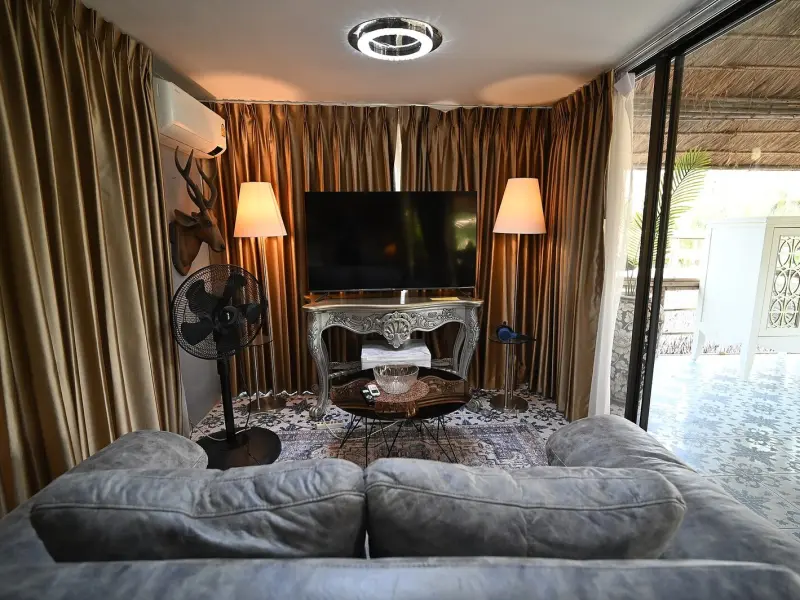
Typical suburban living room, about 14 x 16 feet, with an 84-inch sofa, two chairs and a coffee table: an 8 x 10 works for front legs on; a 9 x 12 lets you go all legs on.
Large or open-plan space, 18 x 20 feet or more: a 9 x 12 or 10 x 14 anchors the seating area. If the room is very large, two rugs can define two zones, such as seating and reading.
Shape and Orientation
Run a rectangular rug in the same direction as the longest piece of furniture, usually the sofa. In a long, narrow room, that also means running it parallel to the long walls.
Round rugs suit round coffee tables, curved sectionals and corner reading nooks. Size them so all front legs of the seating land on the rug.
For an L-shaped sectional, the rug should reach under the front legs of both arms of the L.
Don't Forget the Pad
A rug pad keeps a rug from sliding and bunching, which prevents tripping and makes vacuuming easier. It also adds cushioning and helps protect the floor. Buy a pad about 1 inch smaller than the rug on each side so it stays hidden. On hardwood, use felt or natural rubber pads; some cheap PVC pads can discolor floor finishes over time. Roughly speaking, expect to pay $30 to $120 depending on size and thickness.
Common Mistakes
- Buying the rug before measuring the furniture layout. Always plan the seating first.
- The floating rug. Unless it's intentional and generously sized, go bigger.
- Rug narrower than the sofa. It looks like the sofa is perched on a bath mat.
- Ignoring traffic paths. If people always walk across one corner of the rug, it will wear faster there. Make sure walkways cross the rug fully or bypass it, not clip a corner.
- Thick pile in front of a door. Check clearances before committing.
Budget Tips
If your dream rug only comes in a too-small size within your budget, consider layering: a large, inexpensive jute or sisal rug as the base, with your smaller patterned rug on top. You get the scale of a big rug and the color of the one you love. Indoor-outdoor polypropylene rugs are another affordable option for busy rooms with kids and pets.
The Short Version
Measure your seating group, decide on all-legs, front-legs or a deliberate floating layout, leave 12 to 18 inches of floor at the walls, and tape it out before you buy. In most American living rooms, that lands at 8 x 10 or 9 x 12, bigger than most people expect and usually the right call.